
Written by Sara Marek Kramer
Botswana has always been a study in contrasts—vast yet intimate, untamed yet deeply personal. Nearly 40% of Botswana is protected land, one of the highest levels of conservation commitment in the world. With just 2.5 million people in a country the size of France, space here is inherent.
It is this balance, wild openness paired with quiet intimacy, that makes Botswana unforgettable.
I first traveled to Botswana when I was nine years old. My father owned properties in the country and spent weeks at a time immersed in the bush. I was the fortunate tagalong, proudly claiming the “coolest vacation” in my fourth-grade class: a trip to Africa.
I returned a handful of times over the years. But my most recent visit followed an 18-year absence, long enough for childhood memories to soften into something almost sacred, and for one small unfinished search to remain quietly unresolved.
I wondered what would feel different. And what might still be waiting.
Where Memory Meets Change

I land in Maun in March. Botswana is easing from summer into winter. Mornings are crisp, and afternoons linger with warmth. The land itself feels suspended between seasons, much like I am, somewhere between memory and present moment.
The bar that once stood outside the airport is gone. The office where I once bounced around as a 9-year-old is now a restaurant and shop. The airport has more than just one room.
So much has already changed.
And yet, as I pause and take a deep breath, it feels strangely familiar.
That first night, we stay at Grey’s Eden. In years past, Maun lodging had always been limited and practical at best. But this new property feels intentional—white walls, blue accents, a Grecian feel softened by African design. From the veranda, I look out over a lush, dry riverbed that will soon flood again when the Okavango’s annual waters arrive from Angola, months after the rains fall upstream.
Botswana runs on its own rhythm.
And tomorrow, the safari begins.
The Search Begins
The first camp on the itinerary is Dinaka, set deep in the Kalahari Desert. The Kalahari stretches across much of Botswana, a semi-arid landscape that, for much of the year, appears dry and sparse. But in March, after seasonal rains, it transforms. Grasses rise in soft green waves, and tiny wildflowers scatter across the sand.
The desert feels alive here.
Botswana is home to roughly 130,000 elephants, the largest population in Africa, as well as significant numbers of lions, leopards, and cheetahs. But the animal I most hoped to see was one I had somehow never encountered.
Wild dog.
Fewer than 7,000 African wild dogs remain in the wild, making them one of the continent’s most endangered predators. Botswana is one of their last strongholds.
And so the search begins.
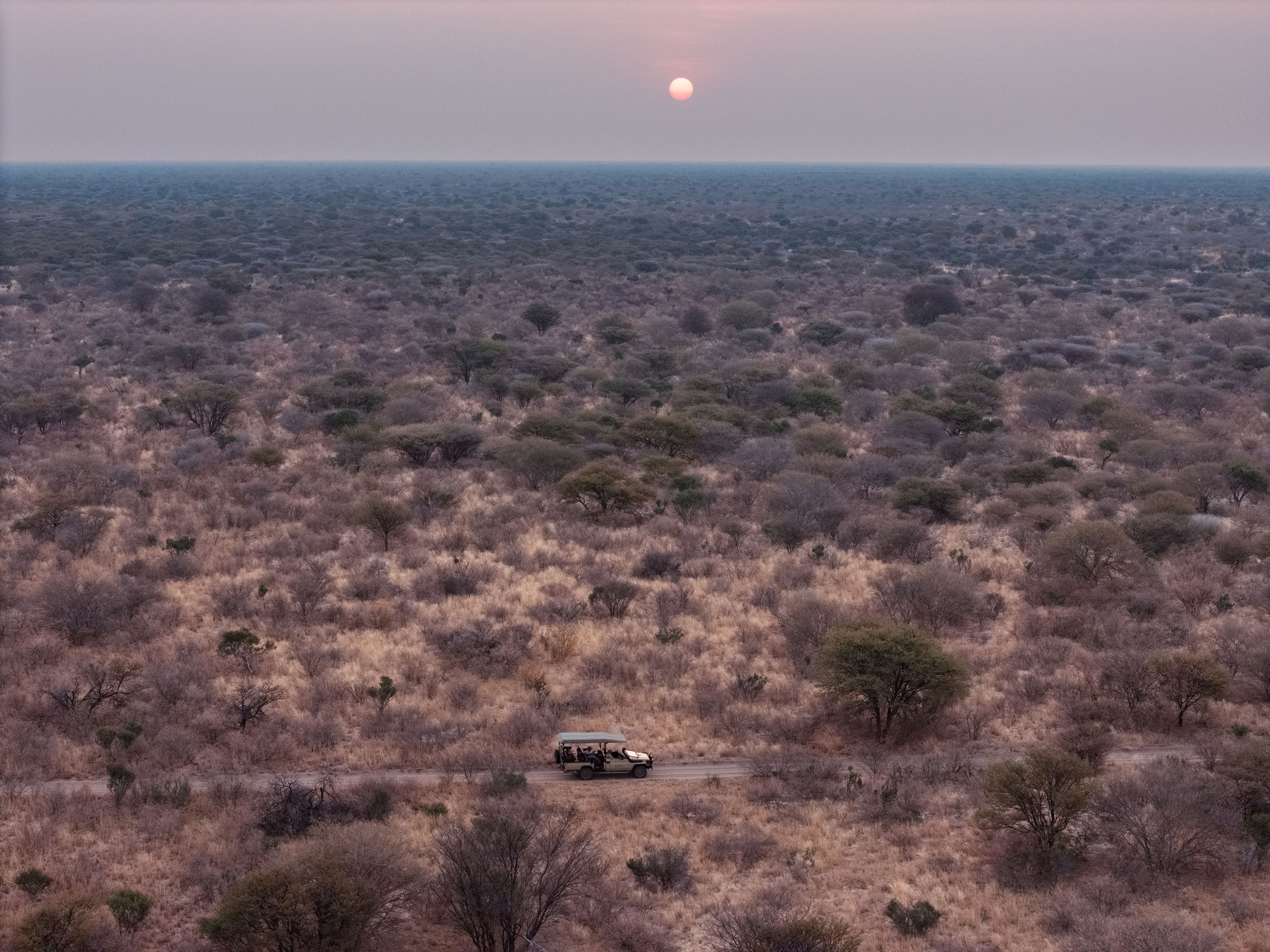
There is something about going on safari with the hope of seeing everything at once. Every encounter feels sacred, as though you have quietly stepped into a world that does not belong to you. Each sighting—lion, elephant, leopard—is a privilege.
But there is something different about searching for one single species. To carry that quiet hope from drive to drive, knowing how rare the opportunity might be. And when it finally happens, even for a moment, it feels like more than a sighting. It feels like something completed.
On our first drive, before we even settle into the rhythm of scanning the horizon, a pride of lions appears, resting directly on the runway. They move with quiet authority, nearly invisible against the sand and grass.
And then I remember, Botswana gives you only what it wants to give you.
That evening, we gather on what may be one of the finest sundowner decks in the country. The Kalahari stretches endlessly before us as the sky softens into pink and gold. A sky full of stars as far as the eye can see.
During my days here, we walk in the footsteps of the San people, whose ancestors have lived in this region for tens of thousands of years. We sit quietly in wildlife hides and watch zebras, warthogs, honey badgers, and even rhinos gather at the watering hole beside camp. The bush does not rush. It reveals itself slowly.
Water in the Desert
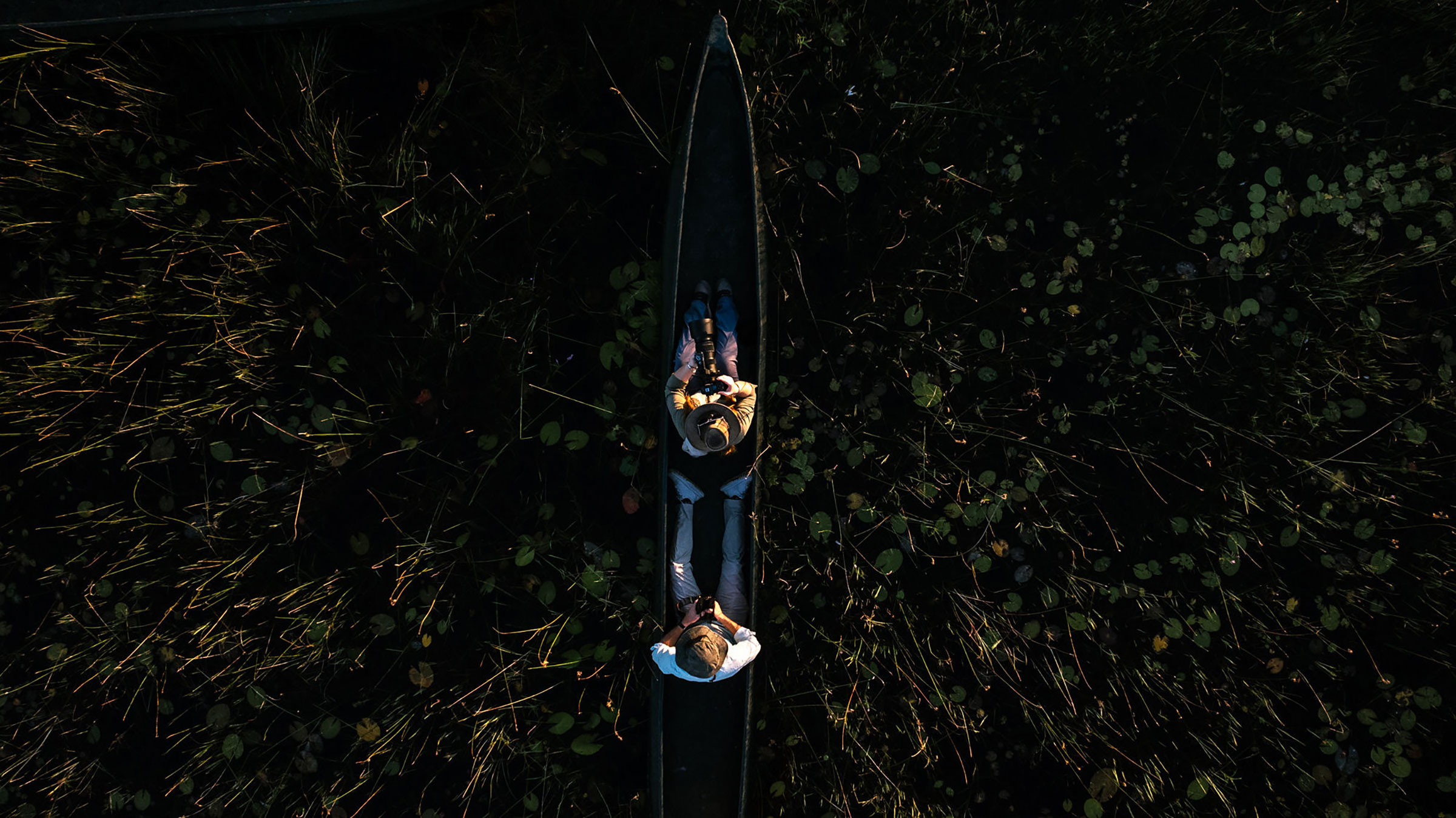
Next, we head into the Delta. The Okavango Delta is one of the world’s great contradictions—an inland river system that flows into the Kalahari and refuses to disappear. Each year, floodwaters travel more than 1,000 miles from the Angolan highlands, transforming the desert into an oasis.
Water where there should be none.
At Maxa, where we are the very first guests, everything feels rooted in place. The design blends seamlessly into its surroundings, and the owners' pride is tangible.

The camp itself is understated and elegant, built with natural materials that echo the tones of the Delta, soft woods, canvas, and textures that mirror the landscape outside.
Large, open spaces invite in light and air, while thoughtful details make each suite feel private and calm. Nothing feels overdone. Instead, there is a quiet confidence in the design, allowing the setting to remain the true centerpiece.
Here, Botswana feels immersive. It’s a slower-paced safari, where every experience feels designed just for you.
Game drives unfold without urgency. There is time to linger at sightings, time to simply sit and listen. In between, we return to camp for long lunches, meaningful conversation, and moments of stillness overlooking the floodplains. Even the silence feels curated.
To fully grasp this landscape, however, you must rise above it, so we then take to the air by helicopter, one of the best ways to understand the Delta’s scale. From above, channels
twist like veins across the earth. In March, many areas are still dry, waiting patiently for the floodwaters to arrive.
The Delta breathes. Expands. Contracts. Changes.
Next, we head to Shinde, a long-standing icon here in the Delta. Set on a lush island at the edge of a permanent channel, Shinde is surrounded by a mix of open floodplains and winding waterways. The camp feels classic and comfortable, with spacious tents raised off the ground and broad decks that overlook the water, where elephants and antelope often pass by.
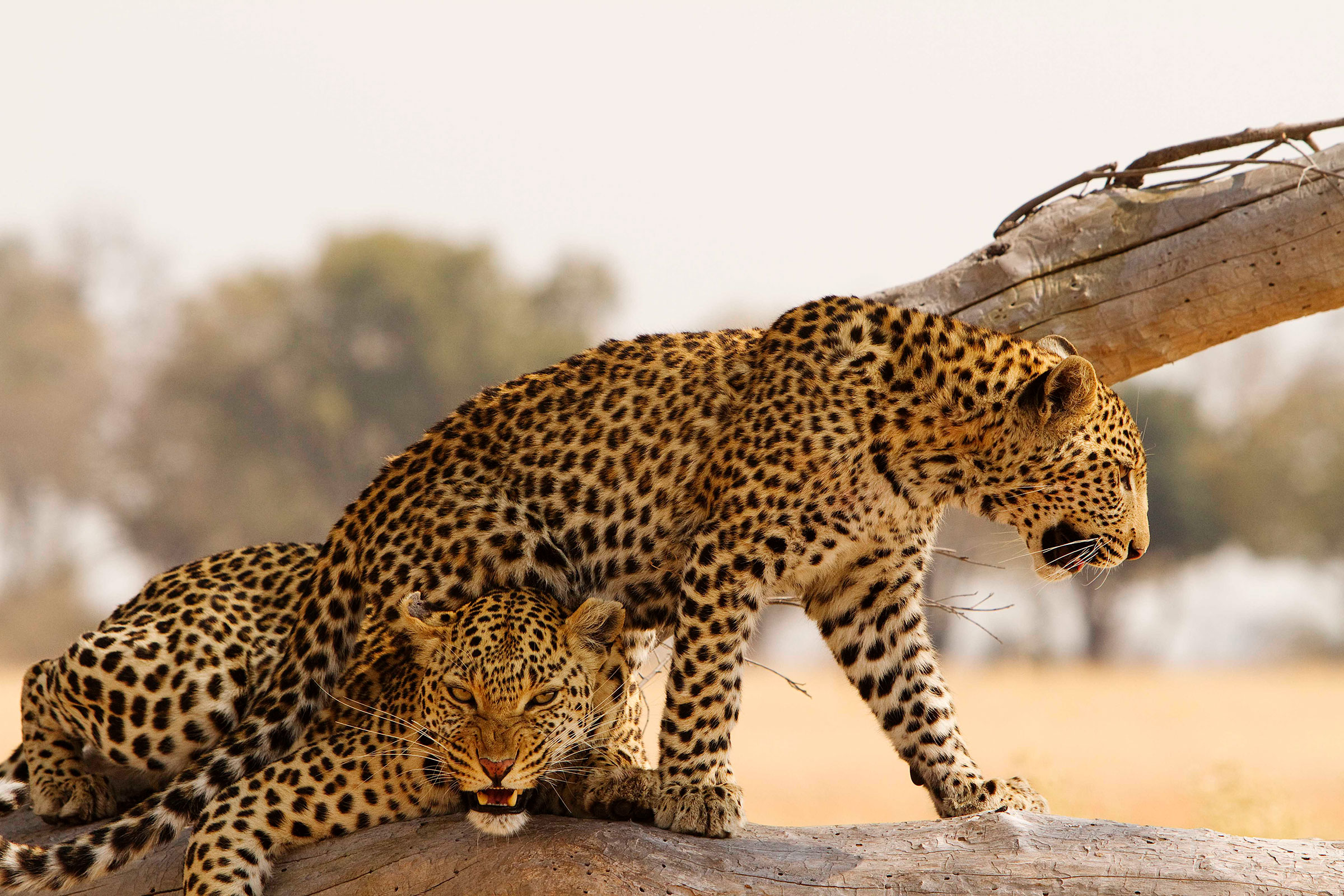
At Shinde, a leopard mother and cub capture our attention. Leopards are solitary by nature, which makes witnessing a mother with her cub especially rare. Cubs remain with their mothers for up to two years, learning patience, stealth, and survival.
But beyond the wildlife, perhaps the Delta's most powerful moment comes at sunrise. Breakfast overlooks the floodplain. The sky turns a shade of orange I have never seen before—deep, saturated, almost unreal.
I cannot recall what we ate, but I will never forget that color.
Or the silence—so complete it rivals the exhilaration of a game drive.
Hope in the Reeds
By now, we have seen so much—lions in the Kalahari, elephants crossing the channels, leopards draped across tree branches. And still, the one animal I have quietly hoped for remains unseen. Maybe now is the time, I wonder, as we head into one of the most wildlife-rich areas of the Delta, the Moremi Game Reserve.

Moremi offers an extraordinary concentration of species, from large elephant herds and buffalo to lion, leopard, and the elusive sitatunga antelope that moves gracefully through the reeds. We spend the next two nights tucked along the banks of the Maunachira River at Okuti, situated at the water’s edge, where pods of hippos gather just beyond camp. Their grunts and splashes become the steady soundtrack of each day and night.
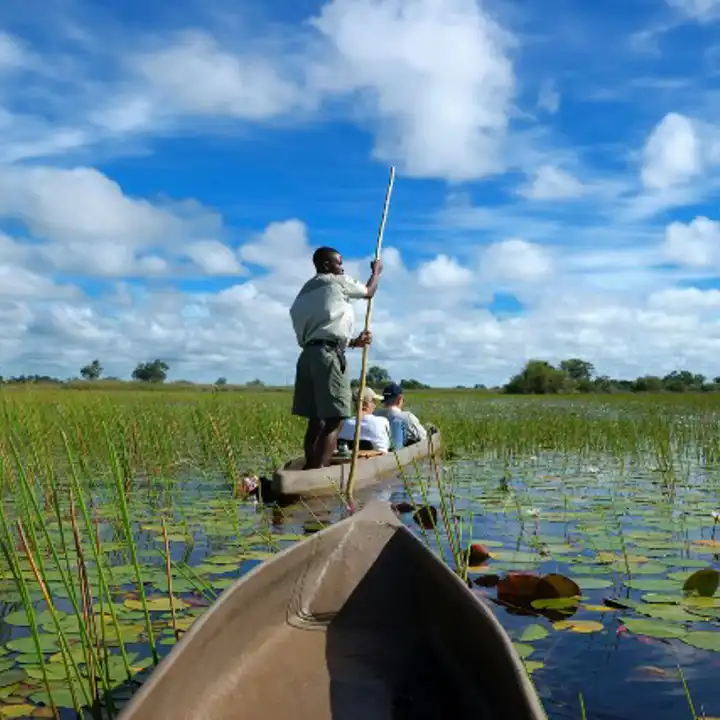
Here, we explore the Delta in two distinct ways, by powerboat and by mokoro, another study in contrasts. In a mokoro, we glide silently through the reeds, guided only by a skilled poler who navigates the narrow channels with quiet precision. The world slows, and every sound feels amplified.
By contrast, the powerboat carries us farther and faster, opening access to broader stretches of water and distant corners of the reserve. Together, the two perspectives reveal the Delta’s range—intimate and expansive, hushed and exhilarating.
We are rewarded with the sight of a single female elephant standing among the reeds, barely acknowledging our presence. Calm. Unhurried. Quietly majestic.
We approach her slowly and linger, watching the steady, deliberate rhythm of her movements. So immense in scale, yet nearly silent as she moves through water and onto land. My mind drifts back to being 9 years old, the first time I traveled through Moremi’s wild landscape. I remember coming across the largest herd of elephants I had ever seen—at least 75, maybe more—moving together in quiet formation. It was the first time I had witnessed something so vast and so alive.
Back then, elephants felt like the pinnacle of safari—everything I had imagined Africa to be.
Now, 18 years later, I realize the search has shifted. The awe remains, but it has sharpened and focused itself on one elusive species. The elephants still move me. But somewhere between childhood and now, the quiet hope for the wild dog has followed me back to Botswana.
The Waiting Pays Off
There is a moment on every safari when you realize your time is growing short. Some travelers may feel ready to return to routine, but I never do. Instead, I feel the quiet weight of something extraordinary drawing to a close.
Leaving the Delta carries a subtle ache—the awareness that experiences like this are rare and never guaranteed.
You begin to wonder when, or if, you will stand in this silence again.
With that feeling lingering, we head north toward our final stop: the Savute Channel. Savute is open and exposed. Dry grasslands stretch wide, broken by scattered acacia trees and the pale line of the Savute Channel cutting through the earth. During our visit, the channel sits empty. Even the elephant herds, for which Savute is known, are fewer this time of year. The landscape feels expansive but sparse.
By now, we have seen elephants, lions, leopards, zebras—more than I can count.
But still no wild dog.
Until the radio crackles. A sighting.
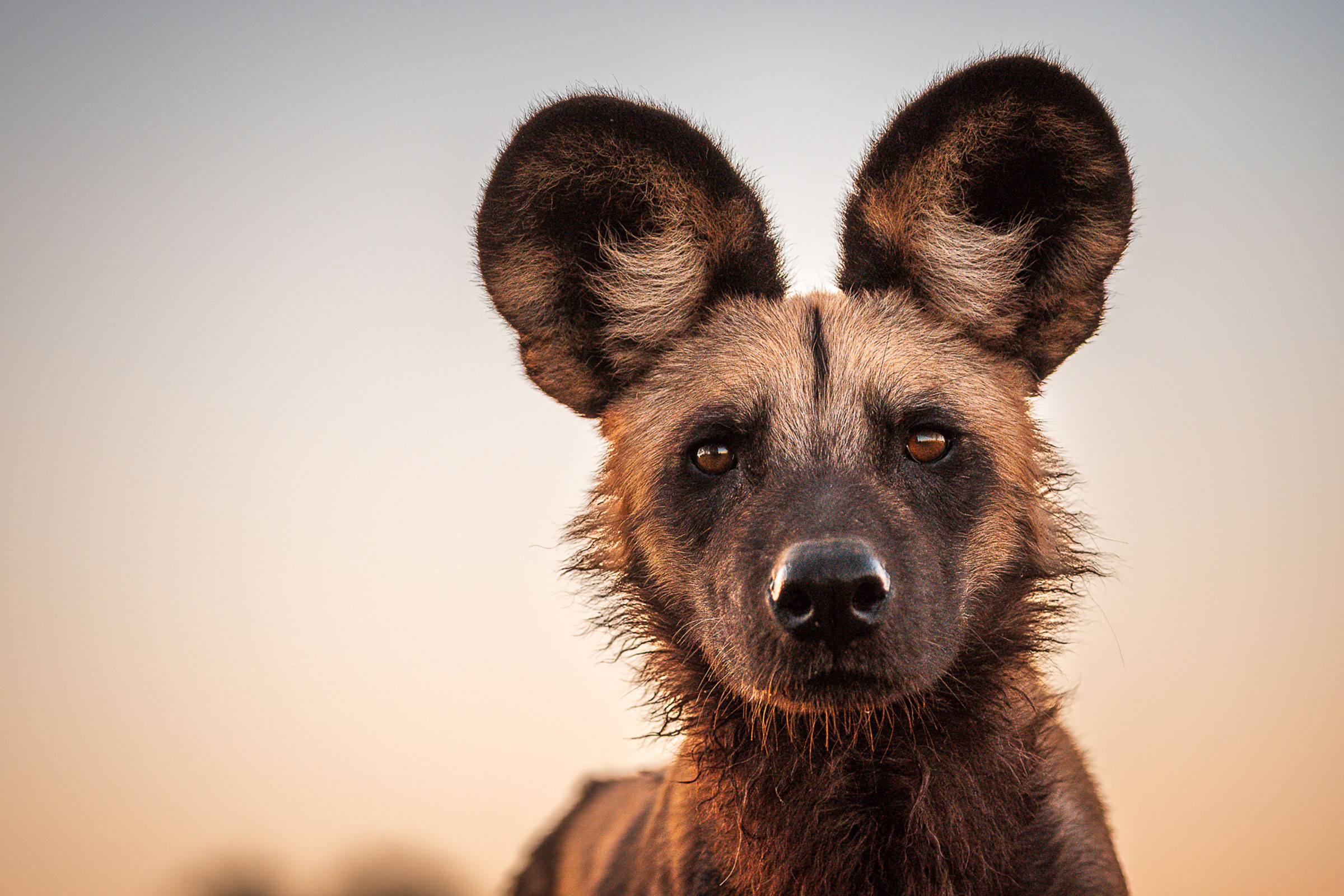
Wild dogs are constantly on the move, covering miles in a single day. We head toward the coordinates, unsure if we will arrive in time.
And then we see them.
A blur of motion near the park gate. Lean bodies. Over-sized ears. Painted coats. They are unlike any other animal in Africa.
Gone in seconds.
We keep going. In a landscape this wide, it would be easy to lose them again. And then, around a bend, there they are—resting in the shade beneath a tree. Ninety seconds. That is all we have.
But ninety seconds is enough.
Eighteen years after my last visit. Decades after my first childhood trip. The one animal I had searched for is finally in front of me.
When the search ends, what lingers is something quieter.
What Remains
So much in Botswana has evolved. Camps are more refined. The infrastructure is stronger. Conservation efforts are globally recognized. Tourism here is intentionally low-impact and high-value, protecting wildlife while supporting local communities.
But what has not changed is the feeling it evokes.

The silence of the bush. The scale of the sky. The humility that comes from watching wild animals live on their own terms.
Botswana reminds you how wild the world still is.
Returning after 18 years to revisit the landscapes that shaped my childhood, this time with a deeper understanding of the world, is a gift.
Wild. Vast. Beautiful. Unapologetically itself.
Botswana is not simply the experience of a lifetime. It is a return to something that had quietly been waiting for me all along.
Botswana
A Paradise for Nature-Lovers and Wildlife Enthusiasts Alike. Discover why a Ker & Downey journey to Botswana is different.
Discover Botswana
Sara Kramer
Sara, a former travel designer, now serves as the Director of Marketing at Ker & Downey. Her extensive travel experience spans several countries across Africa, North Africa, Europe, and South America. Influenced by her travels from a young age, Sara’s global perspective continues to shape her innovative approach to marketing in the travel industry.

Quest Magazine
Dedicated to the experiential style of Ker & Downey travel, QUEST Magazine features eye-opening content that focuses on unforgettable experience, unheard-of destinations, and the very best our world has to offer. Each issue is packed with insider information, what's new in the world of travel, and editorial pieces that focus on our global culture, philanthropy, and transformative travel.
Read The Spring 2026 IssueSee What We Are Up To
Subscribe to our Weekly Newsletter for Travel Tips and Insider Guides for Planning your Next Journey!