
As Told by Haley Beham
I’ve wanted to go to Everest since I was a kid.
My fascination started with Jon Krakauer’s 1997 book Into Thin Air. Then, in 2014, I was finally on my way to trek to Base Camp when an earthquake hit Nepal. I was in the air when it happened. The trip was canceled. I thought my dream was over.
Eleven years later, the opportunity came again, and I knew if I was ever going to do this, now was the time. I’m a decade older, and my feet are too. If I was going to stand at the foot of Everest, I wanted to do it with the best guides, the smartest pacing, and every possible thoughtful comfort available.
That’s how I found myself flying back to Nepal last March.
What Sets This Journey Apart
More than 40,000 people trek toward Everest Base Camp each year.
Most never actually reach it.
Many operators run the trek with a volume-driven approach. They move trekkers quickly. Get in and get out. The trail is crowded, and the pace is often too aggressive. Altitude sickness is common. And for many trekkers, the journey ends at a spray-painted boulder that reads “Everest Base Camp,” with the expedition tents far off in the distance. From there, they must turn around and retrace their steps.
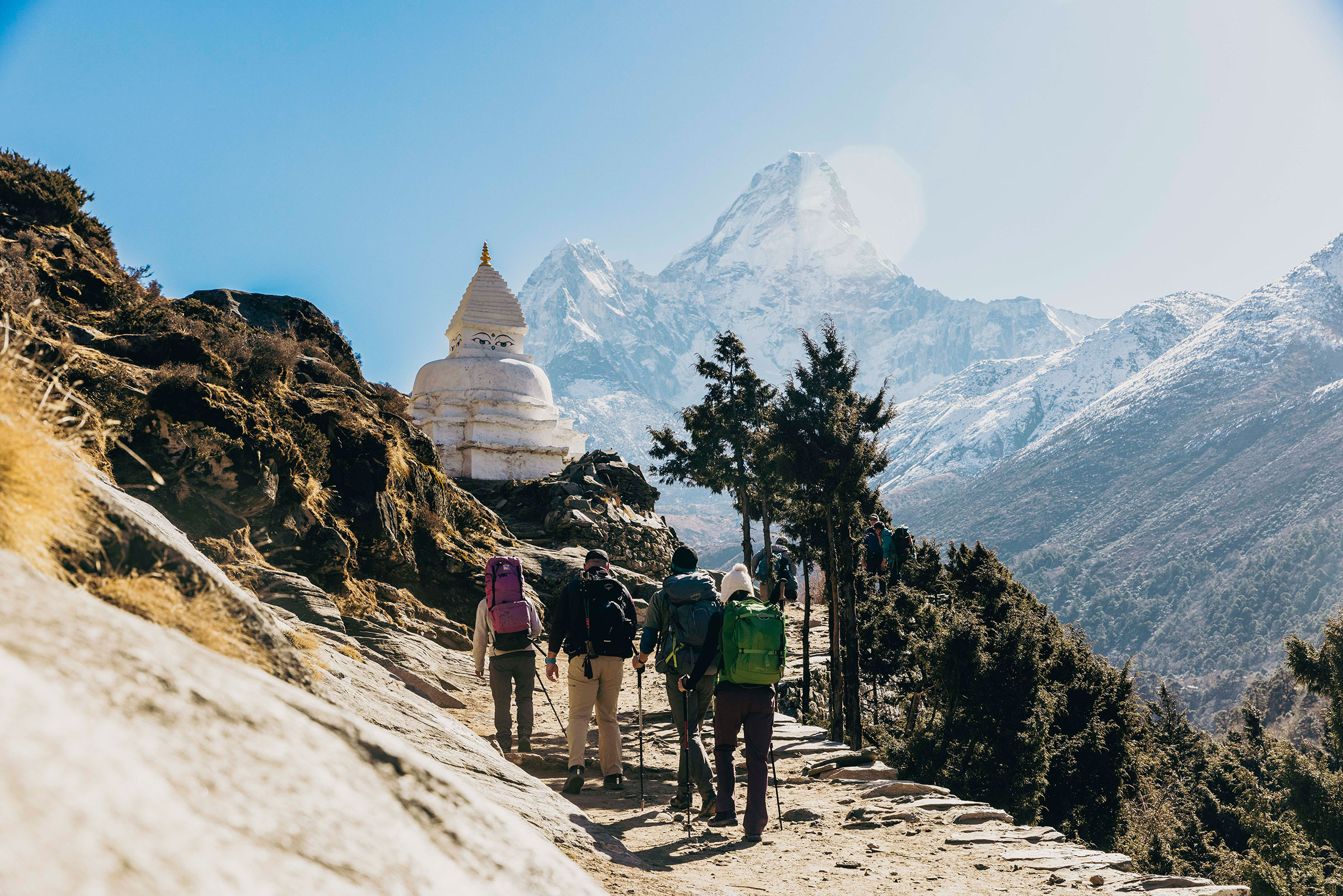
But for this trip, I would be traveling with Rugged Luxury Expeditions, a ground partner who is a registered climbing expedition operator. That distinction allows them to lead their small groups beyond the rock-marked boundary and into Everest Base Camp proper.
The Expedition
The biggest difference between other Base Camp treks and our Rugged Luxury Base Camp Trek is the philosophy of the schedule. Most programs operate on a trekking schedule, whereas the Rugged Luxury Base Camp Trek follows a mountaineering schedule, built around acclimatization, safety, and giving each guest the highest possible chance of success.
The ascent is intentionally slow with strategic rest days. It’s what makes reaching Base Camp achievable. Even with those built-in acclimatization days, this elevation climb up to Everest Base Camp was incredibly hard for me. I can’t imagine attempting it on a tighter timeline.
Into the Khumbu
After a few days in Kathmandu, I fly to Lukla, widely regarded as the most dangerous airport in the world. That is not an exaggeration. The runway tilts upward and ends at a mountain wall.

From there, we begin the 12-day trek to Everest Base Camp at 17,500 feet. Along the route, we cross suspension bridges strung high above rushing rivers, pass mani stones carved with centuries of prayer, and watch snow peaks rise in every direction, larger than your mind can process.
No photograph does it justice.
Our first stop is Phakding, and from there, we weave our way up the Khumbu Valley, past Namche Bazaar and then on to Tengboche. By Namche Bazaar, which sits at over 11,000 feet, the headaches begin. I live at sea level, and altitude is not my strength, so I am thankful for an acclimatization day there.

In Tengboche, we receive a Buddhist blessing before continuing into the high Himalayas, where the air is rarefied, and the scenery is impossibly beautiful.
As we press on toward Base Camp, the air thins even more—and the comforts do, too. Interior heating disappears, and bathrooms move outdoors. Along the route, we stay in the best possible mountain lodges and tea houses, but by Lobuche, our accommodations move to private expedition camps.
It’s tough to stay warm in a tent at 16,000 feet, with temperatures hovering around 10 degrees Fahrenheit. I layer every piece of clothing I have and sleep with a hot water bottle inside my sleeping bag.
At that altitude, everything is hard. Even brushing my teeth takes effort.
These three nights are some of the hardest of my life.
I am nauseated, exhausted, and emotional. I’m not eating, and I’m crying. At one point, I consider asking to be evacuated. Our guide offers a gentle but firm reality check: “You’ll have to improve if you want to go higher.” I am frustrated and nervous about the possibility of not being able to proceed, but looking back, I appreciate that the guide’s priority was my safety.
So, I double my medication. I rest. I focus on getting to Base Camp. That is the goal.
Through the Gates
When I imagined Base Camp, I pictured something the size of a campground.
It is not.
It’s a city of tents stretched across the Khumbu Glacier. It’s easily an hour’s walk from one end to the other. Everything is built atop moving ice and rock, carved fresh each season. Since you must be with a registered climbing expedition, everyone else at camp is preparing to summit.

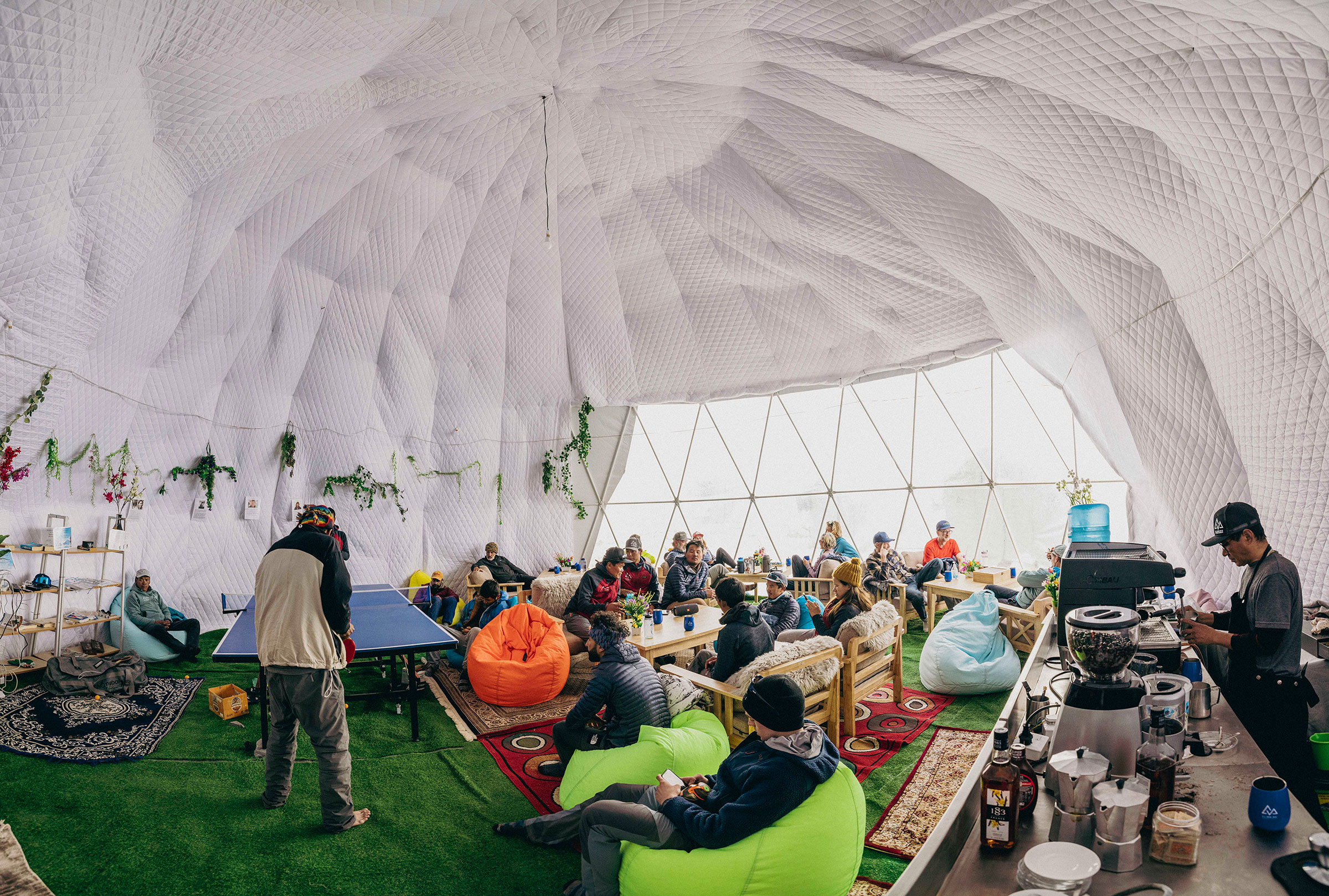
Our campsite sits at the foot of the Khumbu Icefall—impossibly beautiful. Geodesic domes are set up with electricity, proper beds, and heated blankets—luxuries I am glad to have. A chef prepares gourmet meals that I wish I could eat, but at that altitude, I can hardly stomach them. There’s even a tent set up for ping pong (laughable to imagine playing—I can barely make it to the tent!), and a much-appreciated barista making cappuccinos. For those who feel up to it (not me), they also have an ice-climbing clinic on the glacier.

Standing there, at 17,500 feet, I feel the full weight of what Everest means.
And also, honestly, I feel terrible.
Humans are not meant to be at this altitude. I am breathless and nauseated again.
But I am here.
The Descent
After two nights, it is time to leave. Helicopters can only take two passengers at that altitude. When ours finally arrives, I am told to run because the pilots don’t shut off the engine. Running at 17,500 feet feels impossible. My lungs feel as if they’ll burst.
When I depart Base Camp, I’m dressed for zero-degree weather, but when I arrive in Kathmandu, it’s a balmy 80 degrees, and my altitude symptoms have miraculously disappeared. In that moment, I am so grateful that I was able to helicopter down instead of spending several days retracing my steps. Instead of walking down the mountain, I use the time to explore more of Kathmandu, soaking up the culture, basking in the warmth, and reminding myself that I made it.
PRO TIP | “If you live close to sea level, it might be a good idea to spend a few days at a relatively high altitude before the trip. Any advantage you can gain to prepare for being at 10,000 feet and higher for days on end would be a huge benefit.” - Nicole Porto, Travel Designer
Not Quite Ready to Take on Everest?
Getting to Everest Base Camp is a bucket-list destination for many experienced trekkers, but it also comes with challenges. Consider another trek that can also be tackled alongside luxury and expert guiding.
Machu Picchu
See one of the seven wonders of the world the way it was intended, by hiking along the iconic Inca trail. Surrounded by the stunning Andean landscapes, hikers will experience rich cultural heritage along the way and conclude the trek with a celebratory ending at the Sun Gate to Machu Picchu.
Mount Kilimanjaro Summit Climb
Climb to the “Roof of Africa” in Tanzania for another popular trek. With luxury touches like chef-prepared meals, private oversized tents, personal Altox oxygen for summit day, and even a helicopter descent, this expedition provides a once-in-a-lifetime adventure alongside exceptional hospitality.

Quest Magazine
Dedicated to the experiential style of Ker & Downey travel, QUEST Magazine features eye-opening content that focuses on unforgettable experience, unheard-of destinations, and the very best our world has to offer. Each issue is packed with insider information, what's new in the world of travel, and editorial pieces that focus on our global culture, philanthropy, and transformative travel.
Read The Spring 2026 Issue
Talk to A Travel Designer
Get advice and suggestions to make this your perfect trip.
Or give us a call at 800.423.4236.
Inquire NowSee What We Are Up To
Subscribe to our Weekly Newsletter for Travel Tips and Insider Guides for Planning your Next Journey!